At some point in the last few months, I decided to brew something...complicated--a brett finished Tripel with--second use--rosehips. That second use is the key--the plan was to use the rosehips in a mead (1.5 gallon, approx), ferment the rhodomel on them for five days or so, before racking a gallon of the young mead off into a smaller vessel, and racking the Tripel on them for a secondary fermentation. At some point around then, I intend to add brett brux (from Anchorage Brewing dregs) and let it age.
I decided to use the second runnings in a "mini-mash" to make a small table beer.
Sunday, June 21, 2015

Monday, June 1, 2015
Butterbeer recipe
Updated 8-6-16 with the correct butter measurement!
Updated 10-2-17 with some more info on eggs and beer selections. And updated some volumes.
What could be better for a miserable day than buttered beer? This is not the low alcohol stuff from the Harry Potter books, but based on a recipe (modified by my taste) from 16th century England--it's rich, thick, and warms the body and soul. Not to mention clogs your arteries...
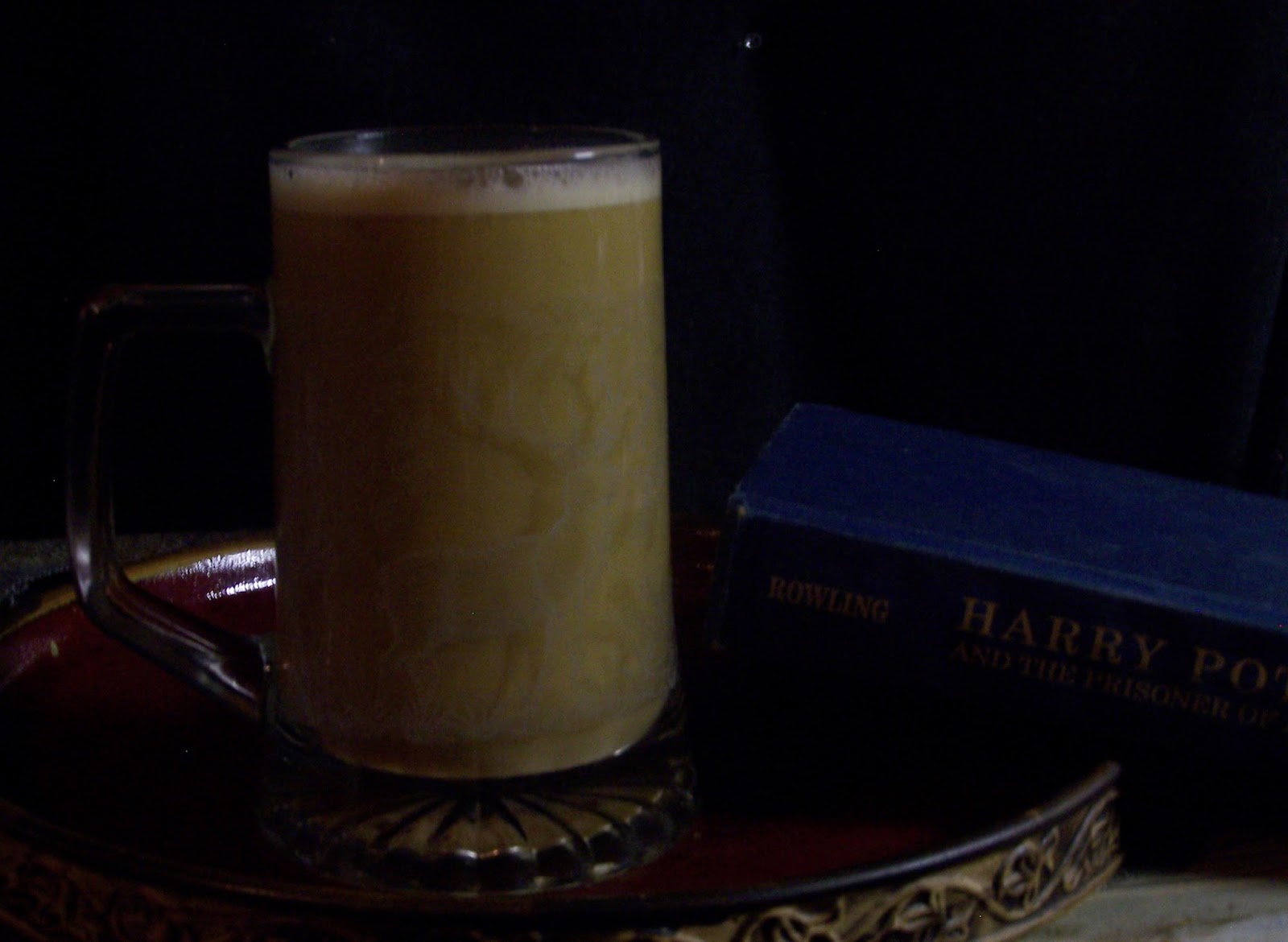 |
| My buttered beer |
Friday, May 29, 2015
Apple Blossom Metheglin

I came up with this recipe a couple of years ago--probably after making my Fireweed blossom mead. Unfortunately, I didn't manage to get to make it last year--I missed when the crab-apple in the yard bloomed.
I am aiming at a floral mead, off dry--I may actually be able to lightly carbonate this one, which would work well with the style.
Monday, April 20, 2015
Black Lagoon Hydromel
One of the earliest meads I made that turned out good. The name comes from the colour--after seeing it, we joked it looked like swamp water. It also got dubbed the colour changing mead, for reasons which will be obvious.
I have also made a honey based (naturally fermented) soda off of this recipe, which was lovely as well.
I have also made a honey based (naturally fermented) soda off of this recipe, which was lovely as well.
Black
Lagoon Hydromel
12
dried juniper berries
10
fresh bay leaves (cracked)
3
(small) sprigs of fresh rosemary
1.25-1.5
pounds honey
I
made a tisane with herbs by boiling for about 10 minutes then letting it steep
for about an hour and a quarter. At the
beginning it was a nice, pale green, after steeping it was a beautiful
cranberry red, and when I added the honey it turned grey—which is a shame, I
would have rather that it stayed red.
Sunday, March 22, 2015
Anchorage Brewing Dregs, Brewing Journal
This post is to document the progress of my first (hopefully) funky brews, using the the dregs from a bottle of Anchorage Brewing's Tide and its Takers.
2-26-15; Drank the beer, and added
about 4oz of apple cider to dregs. I
covered the bottle with foil and left in front of the heater, swirling a couple
times a day. I did add a pinch of nutrients.
3-3-15; Added approximately 1 more
cup of fresh cider to the starter, once there were signs of fermentation (mainly the accumulation of more lees than the dregs could have originally contained).
3-10-15; Saved 1 cup of the starter
in a sanitized mason jar. The rest got
pitched into a gallon of apple cider with a touch of nutrients.
3-20-15;
The cider
tastes lovely. I would say it is around
1.008-1.010 right now, based on taste.
Flavours of citrus and pineapple. I'm having to resist just drinking it fresh--I may very well do so anyways by starting a fresh batch to drink as house cider...
The
mason jar starter has produced krausen, and possibly a pellicle by now; I can’t
tell. I got the brilliant idea to take
two bottles of my Belgian Walnut Graff, pour them into a sanitized 1.5 litre
bottle, pitch the starter, and see what happens (the bottle is airlocked, and
clear). I also added half a bottle of
the Cherry Cyser I was drinking at the time.
I included some of the dregs from the graffs—whatever poured with the
rest. I did not allow the head to
subside completely, and sloshed it around once sealed—this hopefully filled
most of the headspace with Co2.
Time
will tell whether this was a good or bad idea.
At the very least, the starter should be safe in there, and I have a
backup in the form of the cider. The
point of this was to see how the yeast/s perform in a malt based environment,
compared to the cider.
3-22-15; The experiment has signs
of fermentation, with patches of bubbles on the surface.
 |
| 3-22-15. There is nothing I can do about the blurryness--it's residue on the inside from decarbonating the graff. |
©
John Frey, 2015. The Author of this work retains full copyright for this
material. The recipes and other contents
therein may not be used for any commercial purposes.
Monday, March 16, 2015
French Seafood Soup
A fairly classic French soup, utilizing whatever seafood you can get your hands on. I used steamer clams and halibut since that was available, but a greater variety of protein would be better.
2 lb Halibut (or other firm white fish), boned and skinned, and cut into chunks
1 lb other seafood (steamer clams and shrimp will do nicely
2 medium onions, chopped
1 bell pepper, chopped
3-5 roma tomatoes, seeded and chopped finely
2 bay leaves
3-5 cloves garlic
3 tbsp butter
1 heaping tbsp paprika
Cayenne pepper to taste
1 quart fish stock (use bones, skin, etc.)
2 cups dry cider or white wine
Salt and pepper to taste
Saute onions and bay leaves in butter, adding bell pepper and minced garlic when translucent. Cook through. Add the liquids, seasonings, and tomatoes, and cook thoroughly at a simmer. Shortly before serving, add seafood and cook on low until slightly underdone (they will continue cooking off the heat). If you have a variety of seafood, staggering the order so they all finish cooking at the same time may be necessary.
Serve with crusty French Bread and/or rice, and aioli.
Aioli:
1 tbsp lemon juice
3 cloves garlic, ground or pureed
Fresh basil, finely chopped
1 egg yolk, farm fresh if possible
Salt and pepper to taste
1 cup extra virgin olive oil
Using a hand mixer, blend the yolk and lemon juice. Slowly add olive oil a few drops at a time, integrating fully before adding more. Once the mixture has emulsified (started to thicken) you can add a bit more oil at a time. Add the garlic and basil when the mixture has emulsified. S&P at end.
2 lb Halibut (or other firm white fish), boned and skinned, and cut into chunks
1 lb other seafood (steamer clams and shrimp will do nicely
2 medium onions, chopped
1 bell pepper, chopped
3-5 roma tomatoes, seeded and chopped finely
2 bay leaves
3-5 cloves garlic
3 tbsp butter
1 heaping tbsp paprika
Cayenne pepper to taste
1 quart fish stock (use bones, skin, etc.)
2 cups dry cider or white wine
Salt and pepper to taste
Saute onions and bay leaves in butter, adding bell pepper and minced garlic when translucent. Cook through. Add the liquids, seasonings, and tomatoes, and cook thoroughly at a simmer. Shortly before serving, add seafood and cook on low until slightly underdone (they will continue cooking off the heat). If you have a variety of seafood, staggering the order so they all finish cooking at the same time may be necessary.
Serve with crusty French Bread and/or rice, and aioli.
Aioli:
1 tbsp lemon juice
3 cloves garlic, ground or pureed
Fresh basil, finely chopped
1 egg yolk, farm fresh if possible
Salt and pepper to taste
1 cup extra virgin olive oil
Using a hand mixer, blend the yolk and lemon juice. Slowly add olive oil a few drops at a time, integrating fully before adding more. Once the mixture has emulsified (started to thicken) you can add a bit more oil at a time. Add the garlic and basil when the mixture has emulsified. S&P at end.
©
John Frey, 2015. The Author of this work retains full copyright for this
material. The recipes and other contents
therein may not be used for any commercial purposes.
Sunday, March 1, 2015
Kedrigern's Best Brown
For those who know me fairly well, you know that one of my go-to series when I'm upset or need to just curl up and go elsewhere is the Kedrigern series, by John Morressy. Fun read, I recommend it. Anyways, I conceptualized this brew based loosely on something the main character would call for when he is settling in with a book--a classic English brown, modified by my tastes, of course.

I chose a brown porter as the basis, and did some research on the more classic style, before it lowered in ABV% around the time of WWII. Namely, I wanted a somewhat malty, medium strength, brown ale with some hop and English ester character; medium to high body, and medium carbonation--good head would be preferred. I also would have been perfectly happy to add Brett C., but am not yet prepared to do so.

I chose a brown porter as the basis, and did some research on the more classic style, before it lowered in ABV% around the time of WWII. Namely, I wanted a somewhat malty, medium strength, brown ale with some hop and English ester character; medium to high body, and medium carbonation--good head would be preferred. I also would have been perfectly happy to add Brett C., but am not yet prepared to do so.
Subscribe to:
Posts (Atom)